Your packshots are sharp. Your bullets are polished. Then a shopper lands on the product detail page, cannot tell whether the lid twists or the fabric stretches, and bounces. Static images still do the heavy lifting on most e-commerce listings — but marketplace buyers increasingly expect to see the product work before they tap Buy.
AI product videos for e-commerce listings change the production math. From approved packshots, brands can ship short PDP / gallery clips and multi-ratio cutdowns across SKUs — without a studio day per colourway. Done carefully, motion matches what ships. Done carelessly, the clip invents a finish your warehouse cannot deliver. This guide is for marketplace and DTC teams who want the first outcome.
TL;DR
- Listing video ≠ ad creative: the PDP job is to answer the shopper’s top unresolved question in 15–45 seconds, not to win a hook contest. (For social hooks, see our AI UGC ads playbook.)
- Product fidelity comes first: geometry, colour, labels and scale must match the SKU that ships. AI accelerates motion and variants; it does not get to invent the product.
- Ship a pack, not a hero file: gallery master + square/vertical cutdowns + captioned silent versions beat one orphaned MP4 that never leaves Seller Central.
What Is an AI Product Video for Listings?
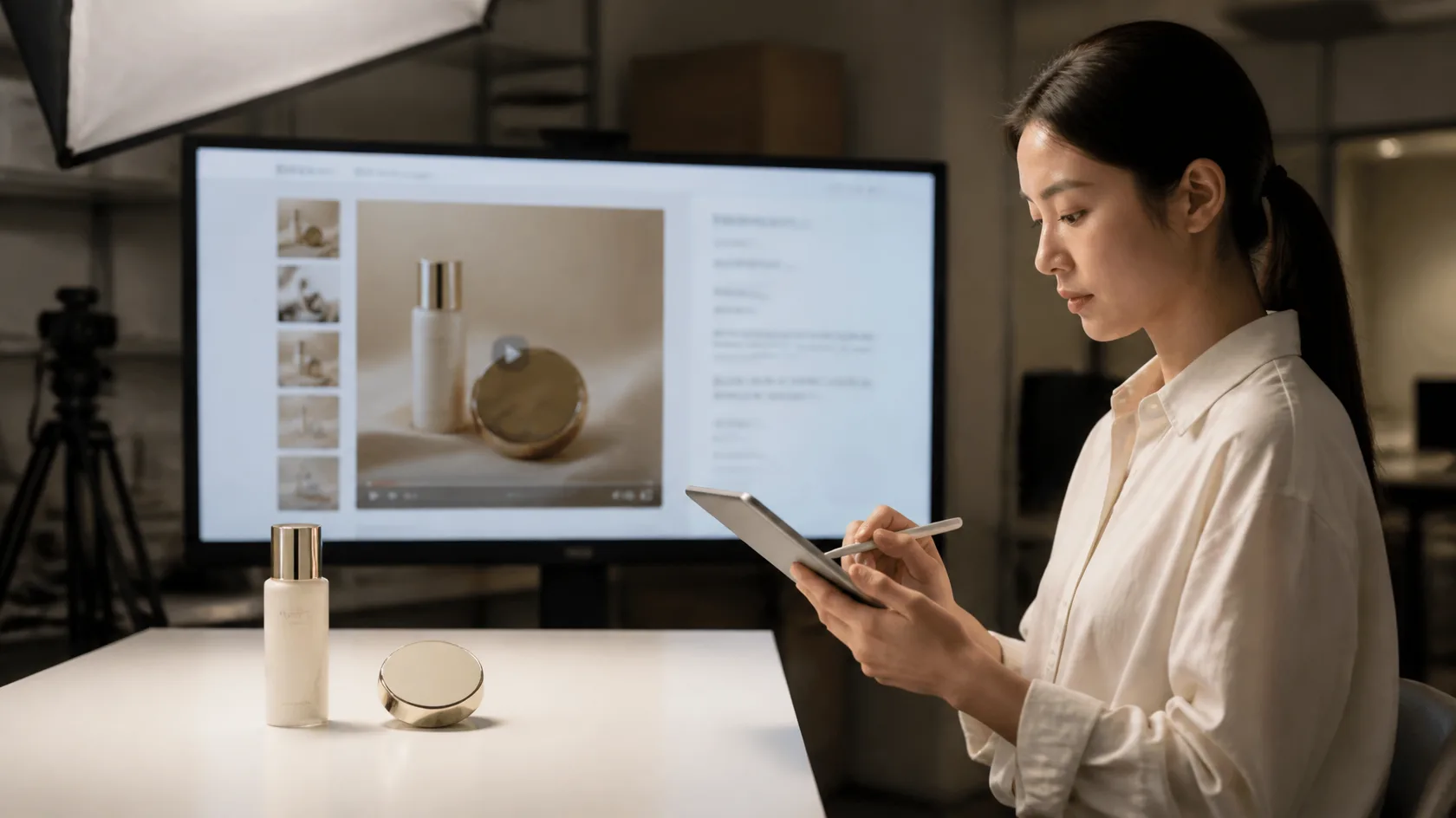
An AI product video for e-commerce listings is a short merchandising asset where some or all of the motion is generated or AI-assisted from real product evidence — approved packshots, 360 stills or a controlled turntable capture. Typical outputs: a 15–45 second gallery / shoppable clip for the PDP, a longer A+ segment for objection handling, and platform-ready ratios for Shopify, Amazon, TikTok Shop and ads.
Keep it distinct from neighbours on the same calendar:
- UGC / performance ads: hook-first creative testing — see our AI UGC ads for e-commerce playbook.
- Explainer / product tour: longer narrative clarity for SaaS or complex offers — see AI explainer videos.
- Brand film: cinematic storytelling with higher production ambition (e.g. our automotive promo guide).
JoJo’s Product Videos list already covers product demos, how-tos, launch and highlight clips — the family marketplace teams mean when they ask for “listing video at SKU scale.”
Why PDP Video Matters (Sourced)
Amazon’s seller guidance places shoppable videos in the main media block of the product detail page — above the fold, next to images — so shoppers can see size, features and functionality that stills cannot show. Amazon’s Sell on Amazon blog reports that product detail pages that added their first shoppable video saw an average 24% increase in sales versus those without video (Amazon, “Let Amazon product videos show customers what images can’t”; Amazon internal data cited there — flag for human review before quoting in sales decks).
Seller playbooks converge on practical gallery rules: lead with the product in use in the first few seconds, keep gallery clips short (often ~15–30 seconds), burn captions for muted autoplay, and reserve longer storytelling for A+ / brand modules (Velocity Sellers, 2026; Amalyze). On Shopify, treat video as first-class product media and assume many mobile shoppers watch muted — so captions matter (Shopify product media docs).
PDP vs Ads vs Explainers
| Asset | Primary job | Typical length | Success metric |
|---|---|---|---|
| PDP / gallery listing video | Answer “does this do what the bullets claim?” | 15–45s | Conversion, returns, Q&A deflection |
| A+ / brand-story video | Handle objections, setup, before/after | 30–90s | Scroll depth + assisted conversion |
| UGC / paid social | Stop the scroll, earn the click | 6–30s | CTR, CPA, creative fatigue |
| Explainer / product tour | Teach a complex offer or workflow | 60–90s+ | Completion, demo requests |
If you only have budget for one clip this quarter, start with the gallery / shoppable listing video. It reaches every shopper who opens the PDP.
Packshot-to-PDP Playbook
1. Freeze the product evidence pack
Collect approved hero packshots, detail crops, colourways and cleared lifestyle frames — plus turntable or 360 sets when you have them. AI should animate evidence, not invent a second product. Mark claims Legal has already approved for on-screen text.
2. Write the one-question brief
One sentence: “For [shopper] who worries about [mechanism / fit / scale / setup], this 20-second clip shows [proof].” Three questions usually means a gallery clip plus an A+ module — not a 90-second kitchen-sink film.
3. Structure the gallery master (≈15–30 seconds)
- 0–3s: product visible and in motion — no logo splash.
- 3–15s: the demonstration (mechanism, fit, pour, snap, stretch, unbox).
- 15–25s: two or three readable text callouts.
- End frame: clean still that summarises the product when the loop pauses.
Amazon’s tips similarly recommend highlighting the most important feature in the first 5–10 seconds and note that many successful shoppable videos land in the 30–90 second range depending on type — match length to the slot you are filling (Amazon shoppable video tips).
4. Generate motion with fidelity controls
Modern AI workflows start from listing photos or a product URL and return short multi-ratio clips. Treat them as production assistants: lock colour and geometry against the evidence pack, reject frames that flatter a finish you do not sell, and keep unpublished pricing out of consumer GenAI accounts. Prefer partners who will not train on your materials without consent — see JoJo’s AI practices.
5. Cut the multi-format pack
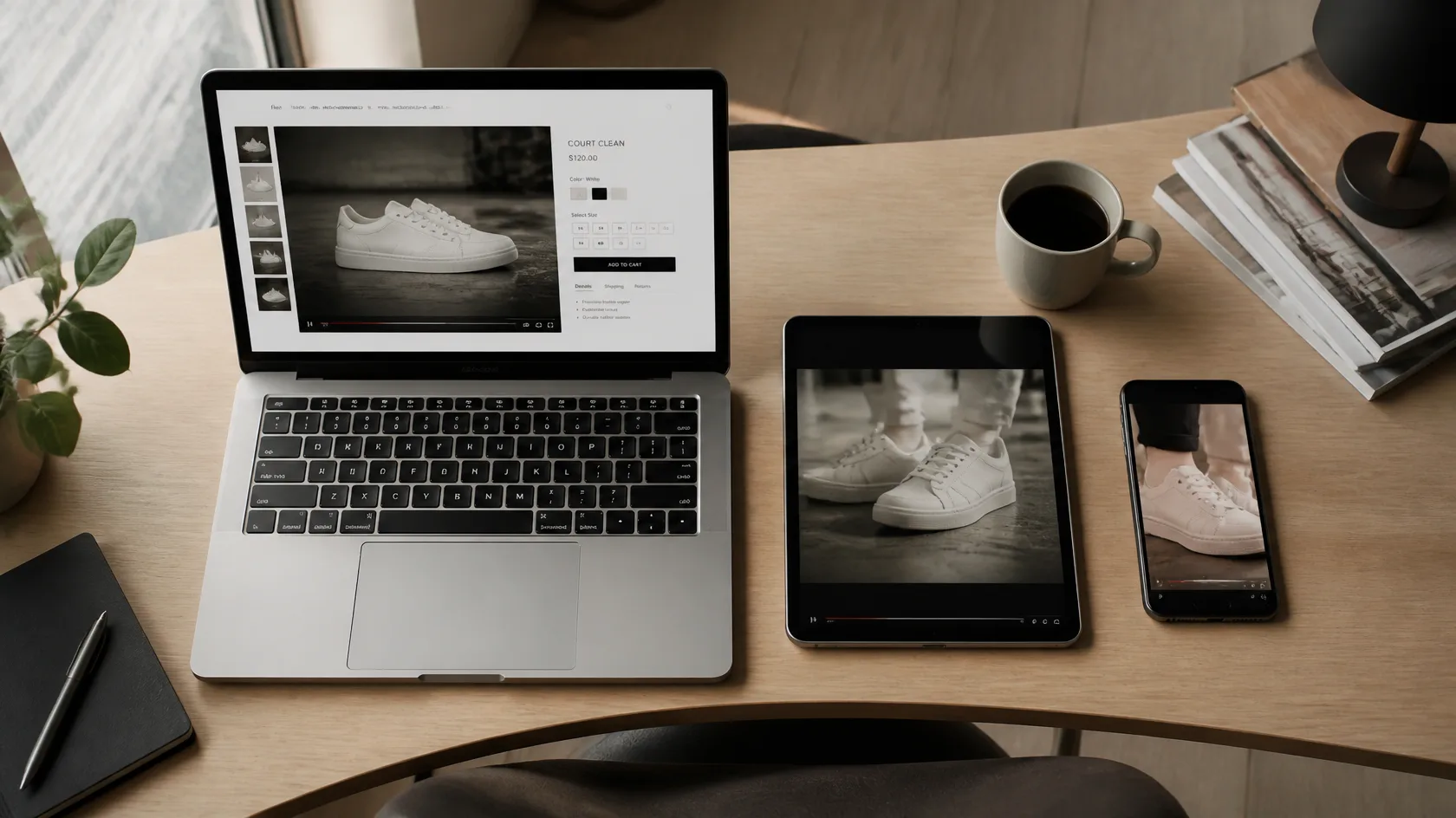
- 16:9 (or marketplace-preferred) gallery master
- 1:1 for feed / mobile-friendly crops
- 9:16 for Shop / Reels / Shorts placements
- Burned-in captions for muted autoplay
- Language variants (EN + Traditional Chinese overlays; Cantonese / Mandarin VO when the channel warrants it)
6. Localise for Hong Kong and APAC
Hong Kong and Greater China listings often need Traditional Chinese on-screen text and careful product-name pronunciation. Produce language packs from one approved master; native-review Cantonese tracks. Multi-language dubbing is an add-on on JoJo’s pricing page.
7. Measure beyond plays
Track PDP conversion, add-to-cart, return rate, “does it include X?” Q&A volume and refresh cadence. Put a refresh date on hero SKUs when packaging or claims change. Listing video decays when the box on screen no longer matches the box that ships.
SKU-Scale Without Losing Governance
- Template the brief: same shot grammar for a category (orbit → detail → use → end card), swap SKU evidence per ASIN / variant.
- Human verify hero SKUs: merchandising + brand sign off masters; long-tail variants follow the locked template with spot checks.
- Disclose when required: for paid placements, check current platform labelling rules (see Does AI Labeling Hurt Ad Performance?).
- Rights and likeness: if a digital human or real model appears with the product, get written consent covering channels, duration and withdrawal.
What Does Listing Video Cost?
Cost follows scope: DIY photo-to-video tools versus managed production, single hero SKU versus catalog batch, ratios, languages and commercial usage.
As a reference point, JoJo’s published pricing starts from HKD 12,000 for 30 video seconds and from HKD 20,000 for 60 video seconds (splittable across clips). Voiceover, localisation, extra ratios and an AI digital spokesperson are add-ons; custom packages cover batch / series work. Compare seconds, SKU count, revisions, cutdowns and training-data terms. (Confirm live pricing before client quotes.)
FAQ
How long should a marketplace gallery video be?
Most gallery / shoppable clips work best short and demonstration-led — often around 15–30 seconds for the in-gallery slot, with Amazon noting many successful shoppable videos in the broader 30–90 second range depending on type. Longer brand storytelling belongs in A+ or a separate module.
Can AI invent lifestyle scenes around my product?
It can generate contextual environments, but the product itself must stay honest. If the scene implies a material, size or function you do not sell, cut it.
Should every SKU get a unique video?
Hero and high-traffic SKUs first. Then templatise: same shot grammar, swap colourways and labels. Identical siblings can share a master with a variant end card when marketplace rules allow.
Our Thoughts
AI product video will not replace merchandising judgment. It replaces the false choice between “only our top three ASINs get motion” and “we wait three months for a studio day.” Treat listing video as a governed production system: frozen product evidence, one-question briefs, multi-ratio packs, SKU templates and disclosure Legal can defend. Speed is the benefit. Product honesty makes that benefit durable — and that is still an agency-plus-human job for brands that care about returns and reputation across Hong Kong and APAC marketplaces.
About Us
JoJo Ventures is an AI-native creative studio in Hong Kong. We help brands and enterprises turn generative AI into enterprise-grade content: AI video production, digital humans and AI avatars for campaigns and product explainers, performance ad creative and AI consultancy, with brand governance and human review built into every project. AI-led production can cut costs by up to 70% compared with traditional shoots (flag). See our Pfizer case study and AI practices.
Ready to pilot AI product videos for your listings? Send us 3–5 approved packshots for one hero SKU (plus the single shopper question you need answered) and we will scope a gallery master plus multi-ratio cutdowns — with optional Cantonese / Mandarin and Traditional Chinese overlays. For quick supporting stills and on-screen graphics, try JifChat.
- Email: business@jojo.ventures
- WhatsApp: +852 9853 7469
- Address: Unit D, 16/F, Boton Technology Innovation Tower, 368 Kwun Tong Rd, Kwun Tong, Hong Kong
Ready to scale your content?
Join Enterprise Brands, leverage our AI creative studio to produce stunning, platform-ready videos at a fraction of the cost.